


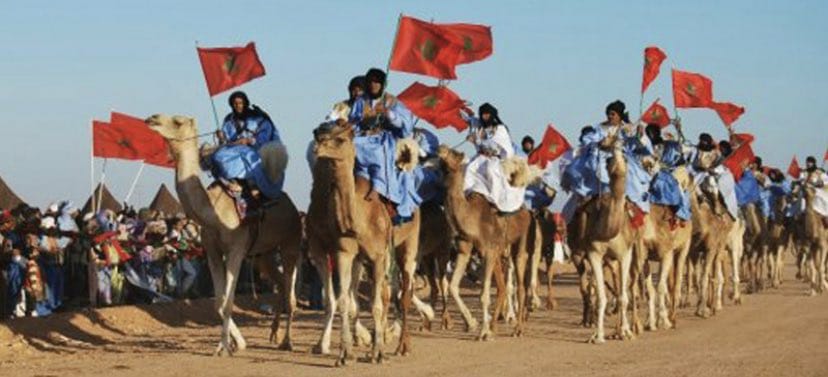
On 6 November 1975, one of the most remarkable peaceful mobilizations in Moroccan history took place — the Green March.
Its legacy isn’t only in geopolitics, but in the deep values of unity, identity, mobilization and sustainability — values that resonate with the Sustainable Development Goals (SDGs) and the mission of the AMALY —Sustainable Development and Environment Moroccan Association.
In the wake of the historic United Nations Security Council resolution (Resolution 2797/2025) which recognized Moroccan sovereignty and advanced the Autonomy initiative for the Moroccan Sahara region, His Majesty King Mohammed VI proclaimed 31 October of each year as Unity Day (Aid Al Wahda), a new national holiday dedicated to national cohesion, territorial integrity and collective identity. (mre.gov.ma)
In this article, we explore eight take aways drawn from the Green March, and how each connects with an SDG and our collective mission for sustainable development in Morocco and beyond.
1. Collective Identity
“Think of our collective identity and values, not just individual ones.”
The Green March reminds us that national progress is built on shared purpose. When hundreds of thousands of Moroccans marched together under a common vision, it was a statement of collective belonging, rather than purely individual ambition.
This lesson links with SDG 16: Peace, Justice & Strong Institutions — because a society that recognizes its shared identity and values builds stronger, more inclusive institutions.
2. Acting Together for Collective Goals
“When people act together, unity becomes power.”
The strength of the Green March came from mass peaceful mobilization. When individuals coordinate, the collective becomes much stronger than the sum of its parts.
In SDG language this is also about SDG 17: Partnerships for the Goals — global and local partnerships, unity of actions, and mobilizing shared resources for sustainable outcomes.
3. Peaceful Strength
“True strength lies in peaceful action.”
A key feature of the Green March: it was non‑violent. The marchers carried flags and Qur’ans, not weapons.
It shows that asserting identity, rights and purpose can be done with dignity and peace.
Again, it connects to SDG 16, emphasizing peaceful societies and citizen engagement.
4. Belonging & Identity
“Belonging & identity foster social stability & pride.”
The act of reclaiming the southern provinces of Morocco was deeply tied to belonging. It reinforced national pride, solidarity and social stability.
This links with SDG 11: Sustainable Cities & Communities — because strong communities are built on shared identity, inclusion and a sense of environmental, social and cultural belonging.
5. Memory & Continuity
“Commemoration keeps values & identity alive.”
Every year, the Green March is commemorated. The act of remembering keeps alive values: identity, solidarity, non‑violence, unity. It transmits them from one generation to the next.
This lesson connects with SDG 4: Quality Education — specifically heritage education, citizenship education, and learning about sustainable values across generations.
6. Strategic Vision & Large Goals
“Lasting goals need sustained effort.”
The Green March didn’t happen by chance. It was prepared; it had leadership, planning, mobilization. The lesson: large goals (like reclaiming territory, or achieving the SDGs in 2030) require vision and sustained action.
We link this with SDG 17 again — because strategic partnerships, long‑term investments and sustained mobilization are at the core of making big goals happen.
7. Throne & People
“Strong institutions + engaged citizens = resilient nation.”
One of the narratives of the Green March is the unity between the Throne (the institution of monarchy) and the People. When citizens and institutions act together in alignment, the resilience of the nation is strengthened.
From the SDG viewpoint, this is again an element of SDG 17 (partnerships) and SDG 16 (strong institutions + citizen participation).
8. Respect for Land & Sovereignty
“Respect for land is respect for life.”
The Green March emphasized Moroccan sovereignty over the land and a respectful approach to territory. More broadly, this reminds us of the importance of land, environment and sustainable stewardship.
It directly links to SDG 15: Life on Land, which focuses on sustainable use of terrestrial ecosystems, land‑use, deserts, forests and biodiversity.
From 1975 to 2030 — Let’s Keep Marching Together
The values taught by the Green March resonate strongly with the SDGs and the mission of AMALY: peace, unity, identity, sustainability, citizens and institutions working together, respect for land and community.
And now, with Unity Day inaugurated on 31 October, these values enter the national calendar as a living‑symbol of what we stand for.
As we approach the horizon of 2030 for the SDGs, let’s remember: progress is not only about economic growth, but about identity, cohesion, sustainable communities, and inclusive heritage.
We invite you — our readers, partners, young people, families — to carry forward this legacy:
- Engage in your community — because your actions matter.
- Remember that together we are stronger.
- Recognize that respect for land, culture, identity and community are part of sustainable development.
- Keep learning, keep sharing the story, build the future.
The Green March stands not just as a historical event, but as a living lesson in unity, identity, peaceful action and sustainable values. The declaration of Unity Day on 31 October 2025 gives us a new annual occasion to reaffirm those values and to deepen their presence in national life. For AMALY, it’s not only about looking back, but looking forward: how do we embody those lessons in our work for children, education, sustainability, community and development?
Let’s keep marching together — from 1975 to 2030 and beyond.